Founding batch now open for preorder · ships spring 2027

Night weaning · 12–36 months

Milk is
sleeping.

A bedtime storybook that explains it, and soft, sleepy-faced patches that show it. Read the story together at bedtime, and when your toddler wakes, the same sleepy friend is there to remind them that milk is sleeping too. A gentle way to end night feeds, built on how little ones learn, and made by a mum who’s been there.

  • Storybook + 14 nights, €25
  • No glue on your nipple
  • Full refund before it ships
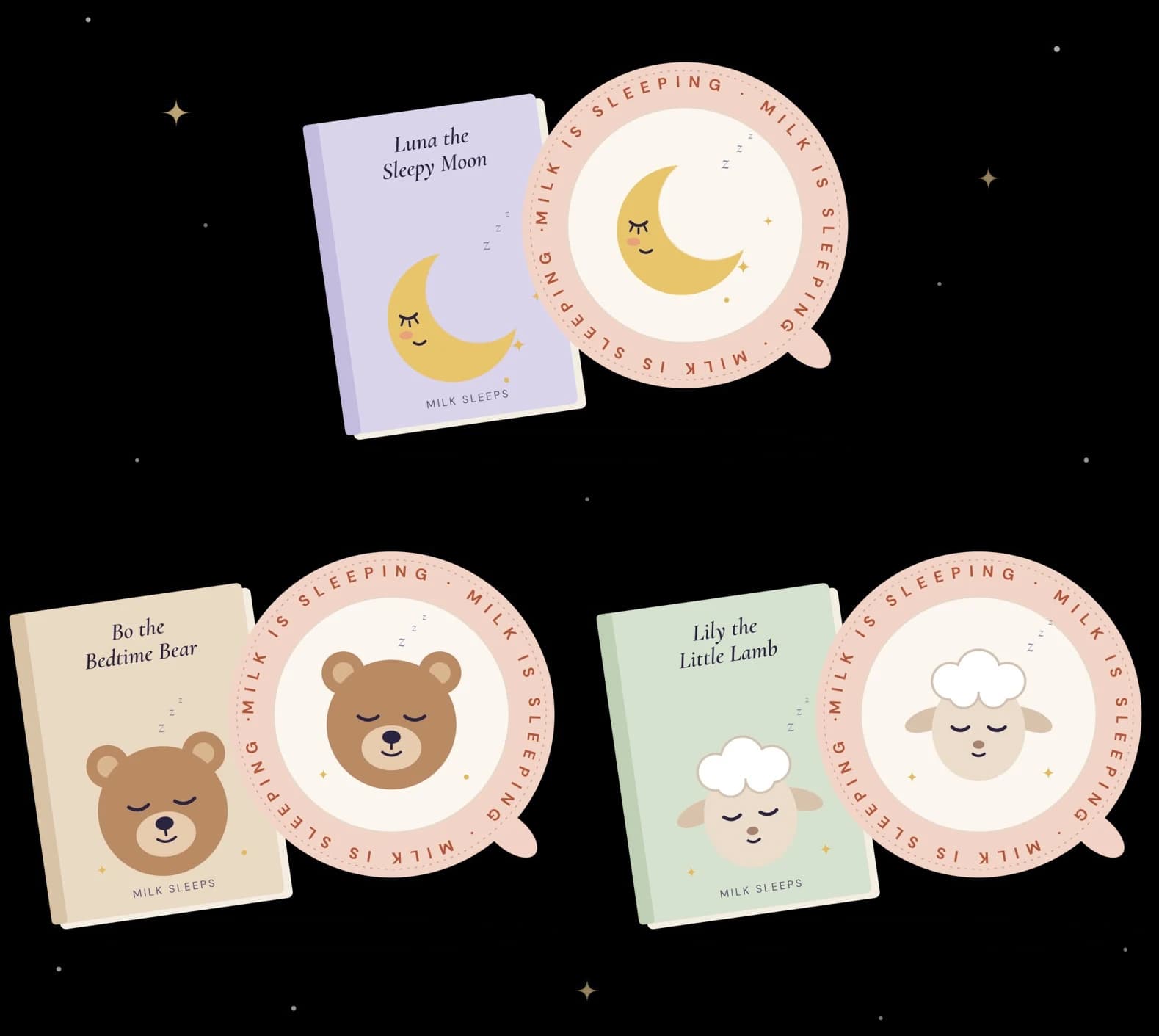
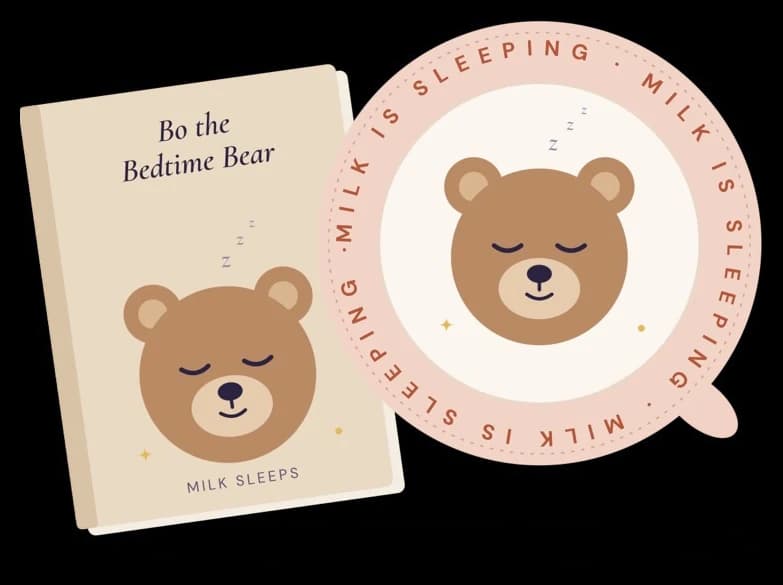
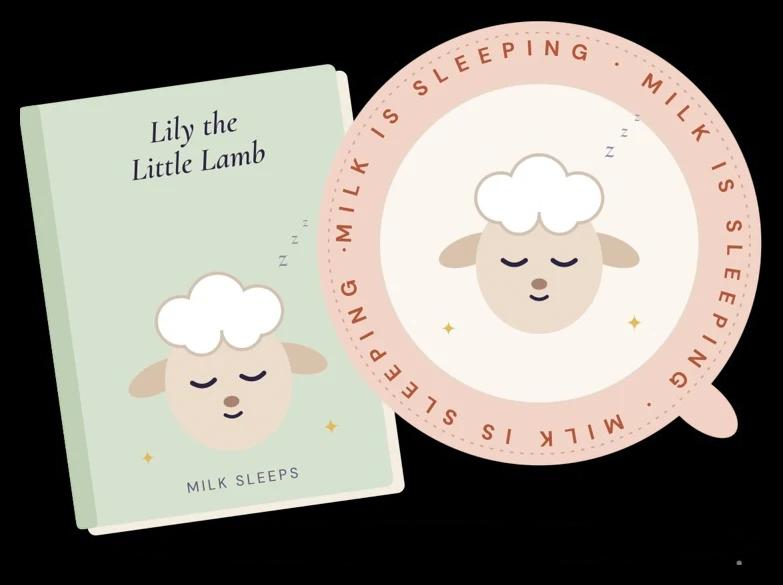
Three Milk Sleeps bedtime books, Luna the Sleepy Moon, Bo the Bedtime Bear and Lily the Little Lamb, each with its matching sleepy-faced “Milk is sleeping” patch

A storybook in every kit

The story explains, the patch shows

Grounded in research

On how toddlers learn and remember

No glue on the nipple

Adhesive only at the soft edge

Made by a mum of two

Designed by Annelise Caron

Sound familiar?

You’re ready to stop night feeds. Your toddler hasn’t had the memo.

You've loved feeding them, and you still do. But it's 2am again, and again at 4, and you can't remember the last time you slept through. Saying “no more milk” to a sleepy toddler is one of the hardest conversations in parenting, and it happens in the dark, half asleep, night after night.

01

The midnight negotiation

They want milk, you want sleep, and “not now” means very little to someone who’s barely awake.

02

The plaster trick

So many mums stick plasters over their nipples so “milk has a boo-boo”. It can work, but plaster glue on delicate skin, peeled off night after night, isn’t kind to you.

03

Nothing made for this

There are shelves of products for starting breastfeeding, and almost nothing to help you end it gently.

A storybook in every kit

The story explains it. The patch shows it.

Toddlers learn from picture books and carry what they learn into real life. Every Milk Sleeps kit comes with a picture book in which a sleepy friend explains that milk goes to sleep at night, just like everyone else. Read it together at bedtime, and when your toddler sees the same sleepy face on the patch, it reminds them of the story.

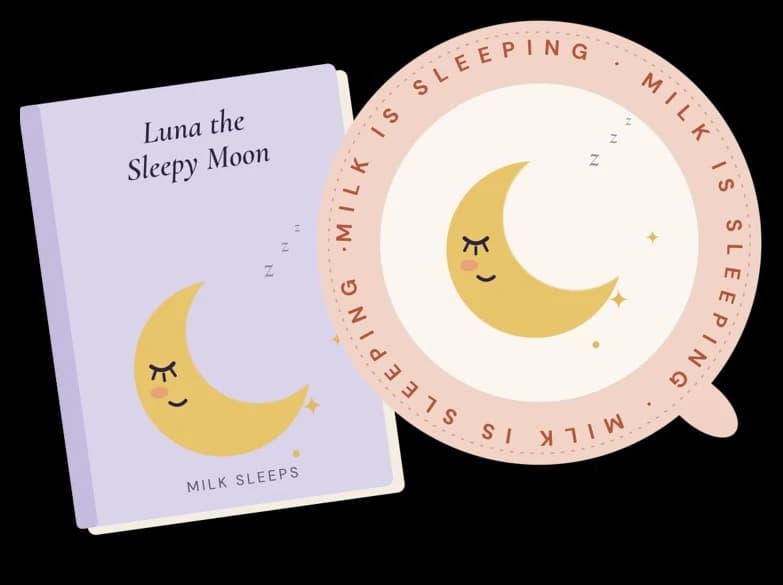
Luna the Sleepy Moon storybook with its matching sleepy-faced patch

Luna the Sleepy Moon

When the sky turns dark, Luna tucks in the stars, the birds and the milk. For little ones who love to say goodnight to the moon.

Bo the Bedtime Bear storybook with its matching sleepy-faced patch

Bo the Bedtime Bear

Big, cuddly Bo is very good at sleeping, and tonight he shows your toddler that milk needs a rest too. For the cuddle-lovers.

Lily the Little Lamb storybook with its matching sleepy-faced patch

Lily the Little Lamb

Soft, gentle Lily knows that night-time is for snuggles, not milk. For toddlers who like their stories quiet and calm.

Choose your favourite. We’ll ask which story you’d like before your kit ships, and your patches will match it.

The patch

A soft patch that says no, kindly.

The patch is soft and disposable, and covers your nipple and areola overnight. It's printed with the same sleepy friend as your storybook, so your toddler sees what they've just heard: milk is sleeping now. It's the same gentle message, every night, without you having to win the argument at 3am.

MILKISSLEEPINGMILKISSLEEPINGMILKISSLEEPINGzzz1234
  1. 1

    Printed top film

    Breathable, printed with the sleepy friend from your storybook.

  2. 2

    No-glue centre

    A soft pad over your nipple. Nothing sticks where it shouldn’t.

  3. 3

    Soft silicone border

    Gentle adhesive only at the edge, made for nightly use.

  4. 4

    Peel-away liner

    Peel, place, sleep. In the morning, peel and bin.

65 mmStandard80 mmLarge

Two sizesStandard (65 mm) fits most mums. Large (80 mm) is for a larger areola. Not sure? We’ll help you choose before your kit ships.

How it works

One sleepy story, four small steps.

Each kit holds a storybook and 28 patches: one for each side, every night, for 14 nights.

  1. 1

    Read the story

    At bedtime, read your Milk Sleeps book together, the same one every night. Luna, Bo or Lily explains that milk gets tired too, and tonight it’s going to sleep.

  2. 2

    Patch on, lights off

    After the last feed, pop a patch on each side. It takes seconds, and there’s nothing to fiddle with in the dark.

  3. 3

    Shh, milk is sleeping

    When they wake and ask, they can see it for themselves, just like in the book. Use the words from the story, then offer a cuddle, a sip of water, a sleepy song.

  4. 4

    Peel and celebrate

    In the morning, peel, bin, and celebrate a brave night together. Then do it again tonight, story first, at your own pace.

The science

The science behind why the method works.

Milk Sleeps is two simple steps. First you explain, with a story at bedtime. Then you do, with a patch through the night. Each step is built on research into how toddlers learn, remember and settle into new habits. Here’s what that research shows, and how we’ve used it.

1 · Explain

The story, at bedtime

Gives your toddler the reason: milk goes to sleep at night, just like everyone else.

2 · Do

The patch, through the night

Shows them the reason when it matters: the same sleepy face and the same words, every time they wake.

Step 1 · Explain

Why a story

Toddlers take what they learn from books into real life

From around 15 to 18 months, toddlers learn new words and actions from picture books and use them in the real world, especially when the real thing looks just like the picture. Books can shift everyday behaviour too: in a randomised trial, toddlers aged 21 to 24 months who looked at a vegetable picture book every day for two weeks liked that vegetable more than toddlers who were only offered it to taste, and were eating more of it three months later.

In your kit

The storybook gives your toddler the reason in a form they learn from: a picture book, read with you. And the patch shows the very same picture.

The same story, again and again

Repetition is how toddlers learn from books. Reading the same picture book more often improved what 18- and 24-month-olds learned from it, whatever the illustration style. Preschoolers who heard the same story repeatedly learned new words that children hearing different stories didn’t. And toddlers have remembered what they learned from a book for up to four weeks.

In your kit

One book, read every night of your 14 nights. The same friend, the same words, the same gentle message, until it’s simply how night-time works.

A calm, predictable bedtime routine

In a randomised trial with 405 families of babies and toddlers, starting a consistent nightly bedtime routine helped children fall asleep faster and wake less often, and for less time, within two weeks. Mothers’ mood improved too. In a survey of more than 10,000 families across over a dozen countries, the more nights a week a routine happened, the better children slept. Reading together is one of the calm, connecting steps researchers describe as part of a good routine.

In your kit

The story becomes a fixed part of your bedtime, so the change happens gently and the same way every night, not as a battle at 3am.

Step 2 · Do

Why a patch

A reminder that matches what they learned

Young toddlers remember best when what they see matches what they learned. In studies with 12- to 18-month-olds, toddlers repeated what they’d learned when an object looked exactly the same, while changing its colour, shape or setting was often enough to stop them. Older toddlers are more flexible, and for them photos of an experience, and hearing the same words again, work as reminders.

In your kit

Your patch carries the exact sleepy face from your book, ringed with the words “milk is sleeping”. When your toddler wakes, picture and words both match the story. Say the line from the book too.

The same answer, every night

Consistency is one of the best-supported ideas in children’s sleep research. A review of 52 studies for the American Academy of Sleep Medicine found behavioural approaches to young children’s night waking worked in 49 of them, and named inconsistency as the biggest stumbling block: if the answer changes after a while, children learn to hold out for longer next time.

In your kit

The patch gives the same answer every night, even at 3am when you’re too tired to hold the line. And it isn’t you saying no. Milk is sleeping.

Explain + do

A signal works best when they know what it means.

Behavioural scientists have studied how young children learn when something is, and isn’t, available. In one study, an adult wore different coloured flower necklaces to signal whose turn it was for attention. On its own, the signal didn’t work: two of the three preschoolers kept asking during “not now”, and the third didn’t reliably ask even when it was their turn. Once the adult explained what each necklace meant, all three straight away asked when the signal said yes and waited when it said no. A review of this research also found that explaining the rule helps children who have the words for it tell “yes” from “not now”.

That’s why Milk Sleeps is a story and a patch. The story explains the rule. The patch is the signal. The pairing is the whole idea.

What the science does, and doesn’t, say

These studies test the ideas Milk Sleeps is built on: how toddlers learn from books, remember, settle into routines and respond to clear signals. None of them studied night weaning, and Milk Sleeps itself hasn’t been through a clinical trial. Some studies were small, and some involved older children.

A story like ours makes most sense to toddlers from around two, as they start to understand being told about things they can’t see. With younger toddlers, the patch, your routine and your calm, consistent response do more of the work, and the story grows with them.

Every child is different, and no method can promise results in 14 nights. What the research gives us is a way to put the odds on your side.

All 18 studies
  1. Brito, N., Barr, R., McIntyre, P., & Simcock, G. (2012). Long-term transfer of learning from books and video during toddlerhood. Journal of Experimental Child Psychology, 111(1), 108–119. doi:10.1016/j.jecp.2011.08.004
  2. Deocampo, J., & Hudson, J. (2003). Reinstatement of 2-year-olds’ event memory using photographs. Memory, 11(1), 13–25. doi:10.1080/741938177
  3. Ganea, P., Shutts, K., Spelke, E., & DeLoache, J. (2007). Thinking of things unseen: Infants’ use of language to update mental representations. Psychological Science, 18(8), 734–739. doi:10.1111/j.1467-9280.2007.01968.x
  4. Ganea, P., Pickard, M., & DeLoache, J. (2008). Transfer between picture books and the real world by very young children. Journal of Cognition and Development, 9(1), 46–66. doi:10.1080/15248370701836592
  5. Hayne, H., MacDonald, S., & Barr, R. (1997). Developmental changes in the specificity of memory over the second year of life. Infant Behavior and Development, 20(2), 233–245. doi:10.1016/S0163-6383(97)90025-4
  6. Heath, P., Houston-Price, C., & Kennedy, O. (2014). Let’s look at leeks! Picture books increase toddlers’ willingness to look at, taste and consume unfamiliar vegetables. Frontiers in Psychology, 5, 191. doi:10.3389/fpsyg.2014.00191
  7. Herbert, J., & Hayne, H. (2000). Memory retrieval by 18–30-month-olds: Age-related changes in representational flexibility. Developmental Psychology, 36(4), 473–484. doi:10.1037/0012-1649.36.4.473
  8. Horst, J., Parsons, K., & Bryan, N. (2011). Get the story straight: Contextual repetition promotes word learning from storybooks. Frontiers in Psychology, 2, 17. doi:10.3389/fpsyg.2011.00017
  9. Mindell, J., Kuhn, B., Lewin, D., Meltzer, L., & Sadeh, A. (2006). Behavioral treatment of bedtime problems and night wakings in infants and young children. Sleep, 29(10), 1263–1276. doi:10.1093/sleep/29.10.1263
  10. Mindell, J., Telofski, L., Wiegand, B., & Kurtz, E. (2009). A nightly bedtime routine: Impact on sleep in young children and maternal mood. Sleep, 32(5), 599–606. doi:10.1093/sleep/32.5.599
  11. Mindell, J., Li, A., Sadeh, A., Kwon, R., & Goh, D. (2015). Bedtime routines for young children: A dose-dependent association with sleep outcomes. Sleep, 38(5), 717–722. doi:10.5665/sleep.4662
  12. Mindell, J., & Williamson, A. (2018). Benefits of a bedtime routine in young children: Sleep, development, and beyond. Sleep Medicine Reviews, 40, 93–108. doi:10.1016/j.smrv.2017.10.007
  13. Owen, L., Kennedy, O., Hill, C., & Houston-Price, C. (2018). Peas, please! Food familiarization through picture books helps parents introduce vegetables into preschoolers’ diets. Appetite, 128, 32–43. doi:10.1016/j.appet.2018.05.140
  14. Saini, V., Miller, S., & Fisher, W. (2016). Multiple schedules in practical application: Research trends and implications for future investigation. Journal of Applied Behavior Analysis, 49(2), 421–444. doi:10.1002/jaba.300
  15. Simcock, G., & DeLoache, J. (2006). Get the picture? The effects of iconicity on toddlers’ reenactment from picture books. Developmental Psychology, 42(6), 1352–1357. doi:10.1037/0012-1649.42.6.1352
  16. Simcock, G., & Dooley, M. (2007). Generalization of learning from picture books to novel test conditions by 18- and 24-month-old children. Developmental Psychology, 43(6), 1568–1578. doi:10.1037/0012-1649.43.6.1568
  17. Simcock, G., & DeLoache, J. (2008). The effect of repetition on infants’ imitation from picture books varying in iconicity. Infancy, 13(6), 687–697. doi:10.1080/15250000802459102
  18. Tiger, J., & Hanley, G. (2004). Developing stimulus control of preschooler mands: An analysis of schedule-correlated and contingency-specifying stimuli. Journal of Applied Behavior Analysis, 37(4), 517–521. doi:10.1901/jaba.2004.37-517

Every study above is peer-reviewed and linked to the original paper, so you can read it for yourself.

Gentle by design

Kind to your toddler. Kind to you, too.

Go at your pace

Drop night feeds gradually. Your body adjusts best with time, and so does your little one.

Listen to your body

If your breasts feel full or uncomfortable, slow down and speak to your midwife, health visitor or a lactation consultant.

Bin it safely

Used patches go straight in the bin, well out of reach of little hands.

Why Milk Sleeps

Why not just a plaster?

Made for night weaning
PlastersNo
Reusable coversYes
Milk SleepsYes
On your nipple
PlastersPlaster glue
Reusable coversSilicone
Milk SleepsNo glue at all
Explains it, then shows it
PlastersOnly if you draw on it
Reusable coversPrinted cue, no story
Milk SleepsStorybook + matching face
Every night
PlastersPeel and bin
Reusable coversWash, dry, re-stick
Milk SleepsPeel and bin
Price
PlastersAlmost free
Reusable coversAround €30
Milk Sleeps€25 for 14 nights, storybook included

A.C.

Annelise Caron · founder & mum of two

Our story

Made with love, by a mum who’s been there.

Hi, I’m Annelise.

I fed both of my children through more nights than I could ever count. I treasured those quiet hours. And with each of them, there came a moment when I knew it was time for the night feeds to end.

What nobody tells you is how hard it is to explain that to someone so small and so sleepy. I looked for something gentle, something made for this moment, and found nothing but advice to “be consistent” and mums swapping tips about sticking plasters on their nipples.

So I made Milk Sleeps: a bedtime story that explains it, a soft patch that shows it, and a kinder way to say “not now, my love”. It’s for the end of a chapter you’ll always treasure, and the start of more sleep for everyone.

With love, Annelise
Preorder

Join the founding batch.

Preorder today and you’ll be one of the very first families to try Milk Sleeps: a storybook to read together and 14 nights of matching patches. We’ll keep you posted as your kit is made, and send it your way as soon as the founding batch is ready.

  • Full refund any time before your kit ships
  • Due to ship spring 2027
  • Updates from Annelise as the founding batch comes together
Founding batch

The 14-Night Kit

€25storybook + 28 patches

  • A Milk Sleeps storybook: choose Luna, Bo or Lily
  • 28 patches with the same sleepy face: one for each side, every night for 14 nights
  • Soft silicone border, no glue on your nipple
  • Founding batch, shipping spring 2027
Choose your size

Full refund any time before your kit ships.

Questions

Everything you’re wondering.

Something we haven’t answered? Write to us at hello@milksleeps.com. We read every message.

When will my kit ship?

Your preorder reserves a kit from our founding batch, which is due to ship in spring 2027. We'll email you updates as it comes together, so you're never wondering.

What age is Milk Sleeps for?

Toddlers of roughly 12–36 months who are ready to let go of night feeds. Most little ones start to follow a simple story like "milk is sleeping" from around 18 months to two years; with younger toddlers, the patch and your nightly routine do more of the work. Every child is different, and you know yours best.

What's the storybook for?

Toddlers learn from picture books and carry what they learn into real life, especially when the real thing looks just like the picture. In the book, a sleepy friend explains that milk goes to sleep at night, just like everyone else. Your patches carry the same sleepy face and the same words, so when your little one wakes and asks, what they see matches the story they've heard. Read it together every night as part of your bedtime routine.

Is there science behind Milk Sleeps?

Yes. Milk Sleeps is built on well-researched ideas about how toddlers learn: they take lessons from picture books into real life, learn through repetition, remember best with reminders that match what they learned, and respond better to a clear signal when the rule behind it has been explained. Milk Sleeps itself hasn't been through a clinical trial, and no method works the same way for every child. You'll find each study, and what it does and doesn't show, in the science section above.

Which story do I get?

You choose: Luna the Sleepy Moon, Bo the Bedtime Bear or Lily the Little Lamb. Each tells the same gentle message with a different sleepy friend, and your patches will match. We'll ask which one you'd like before your kit ships.

Is there glue on my nipple?

No. The adhesive is only on the soft silicone border at the edge of the patch. The centre, which sits over your nipple, has no adhesive at all.

Which size do I need?

Standard (65 mm) suits most mums. Choose Large (80 mm) if you have a larger areola. If you're not sure, pick "Not sure yet" and we'll help you choose before your kit ships.

What's in a kit?

One storybook and 28 patches: one for each side, every night, for 14 nights. Some little ones take to it quickly and some need longer, so go at your own pace.

What if my toddler doesn't take to it straight away?

Night weaning is a journey, not a switch, and some nights will be easier than others. Milk Sleeps makes the message clear and kind; your cuddles, patience and a sip of water do the rest.

Is Milk Sleeps a medical device?

No. Milk Sleeps doesn't treat or prevent anything. It's a gentle visual cue to help with night weaning. Cutting down feeds can leave you feeling full or uncomfortable, so drop night feeds gradually and speak to your midwife, health visitor or a lactation consultant if you have any concerns.

Is it safe around my toddler?

Bin each used patch straight away, out of reach of little hands, and keep unused patches stored safely, as you would plasters or medicines.

Can I cancel my preorder?

Of course. Email us at hello@milksleeps.com any time before your kit ships and we'll refund you in full.

Milk is sleeping.
Soon, so will you.

Preorder the founding kit, storybook included, and be among the first families to read it at bedtime.

Preorder for €25